October Event Insights: What We Learned at World Aviation Festival and IATA World Passenger Symposium 2026

Offer-led retailing is where the commercial value sits
With margins per ticket still razor-thin, airlines are focused on two things: efficient distribution and selling beyond the fare. NDC channel shift is already delivering real cost-of-sale savings, but it’s ancillaries, bundles, and smarter offers that make the business case.

Modularity is how airlines are transforming
Airlines want flexibility, adopting capabilities incrementally, and working with their existing systems. Modular and open platforms came up in almost every session, and offer optimisation is the next focus for many airlines.
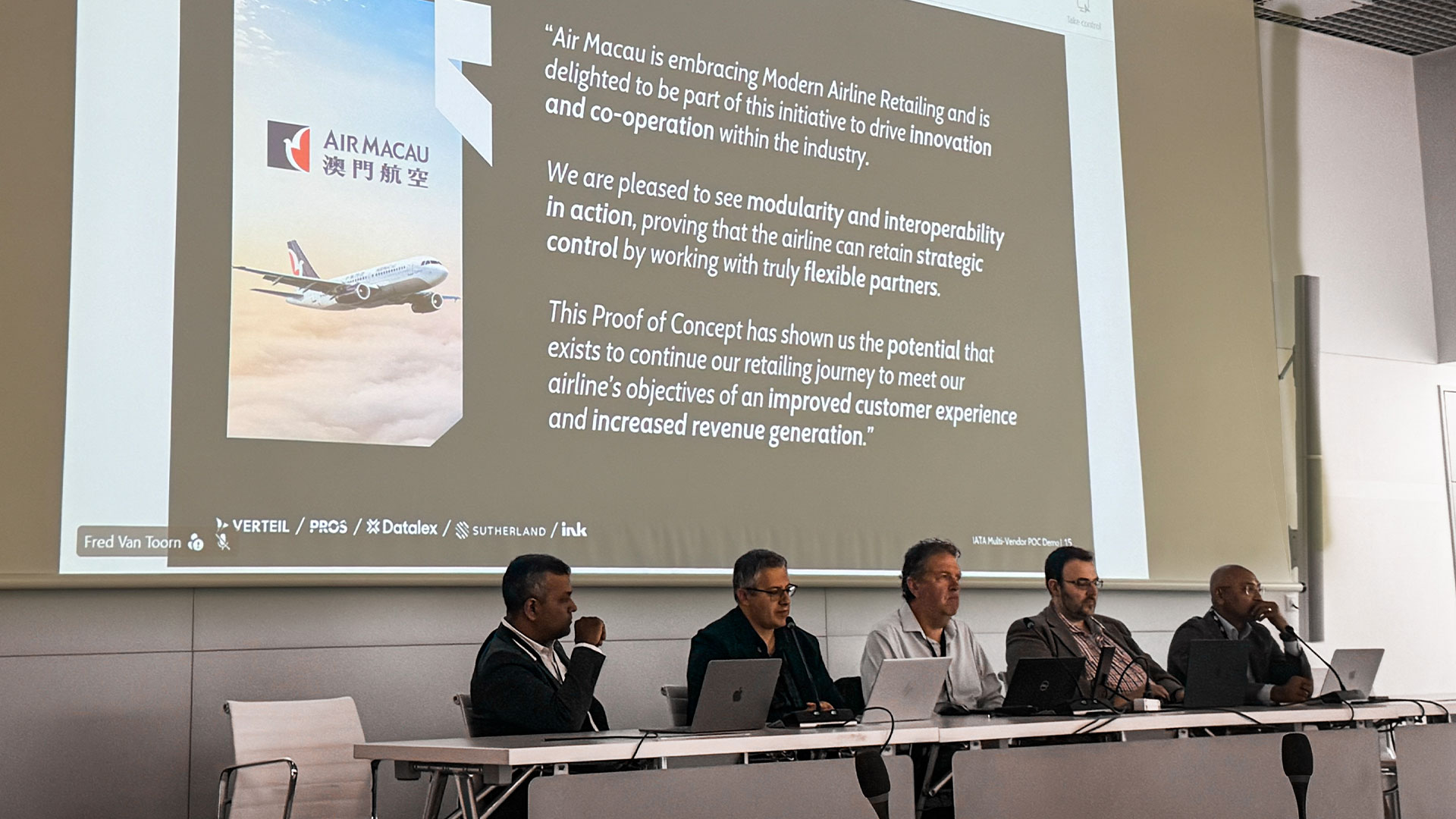
It’s an approach Datalex put into practice in its winning multi-vendor IATA POC, working alongside partners to bring best-of-breed capabilities together. At IATA’s WPS event, we took the stage with partners Ink Innovation, PROS, Sutherland, and Verteil to show best-of-breed in action: one connected customer journey, from shopping and booking through servicing and check-in, to the flight flown and all services delivered.

Payments are a big part of the conversation
Payments came up throughout the events. They’re easier to tackle than they used to be, with more vendors now offering solutions to help modernise payment infrastructures. Airlines now recognise the role payments play in both customer experience and revenue generation: customers expect more ways to pay and a fast, simple checkout, and failed payments mean lost sales. That’s why payments are becoming a central part of roadmaps.
In Datalex’s research report, The Airline Leadership View 2026, 41% of global airline leaders surveyed said payments are an important differentiator. The top payment opportunities they identified include higher conversion through broader local and alternative payment methods (31%), simpler, faster checkout journeys (30%), and revenue from dynamic currency conversion (26%). Find out more here.

AI Agents are helping airlines recover customers during disruption
AI is changing how customers shop, but it’s also changing how airlines look after customers when things go wrong. Using AI agents to recover customers during disruption (IROPS) is becoming a customer experience priority. IROPS is also starting to move out of the PSS and become agent-led, enabling airlines to meet tougher regulations such as EU261 compliance.

AI search is sending customers to OTAs, not airlines
When a customer searches for a flight using AI assistants, the results often link to OTAs rather than airlines, and airlines risk losing the direct customer relationship. It’s tempting to put that down to OTAs integrating better with AI, and they have launched apps within these platforms ahead of airlines. But it’s just as much about content, with every airline in one place, OTAs give AI richer information to draw on.
Many airlines are starting to respond, for example easyJet and Southwest have both launched ChatGPT plugins this month, embedding their offers in the AI channel and linking customers back to the airline to complete their order.
It raises a new question in the industry; if AI is doing the searching, how does an offer get personalised? In short, offers need to be discoverable and readable by AI.

Smart bundling comes down to simple tactics
Bundling got plenty of airtime at conferences this year, and the lessons were practical. Products in bundles should stand alone rather than being tied to a fare class, customers need to see the value difference, and airlines should test bundles and iterate quickly where needed.

Personalisation is harder than is seems
Contextualising an offer is easier than truly personalising it. It’s important to focus on segments, not individuals, and respond to what’s driving demand. Airlines must sell the right product at the right moment and keep complex products out of the booking flow.

Post-Booking: Revenue Opportunity
The sale doesn’t end at booking. Customers like to self-service and add extras, such as fast-track security or parking, in one simple checkout, and it’s a real revenue opportunity for airlines.

In summary, it’s clear that the future of airline retailing is offer-led, modular and AI-ready. Airlines are focused on selling beyond the fare, and on introducing new capabilities incrementally rather than through big-bang transformation. AI search is already sending customers to OTAs instead of airlines, so offers need to be easy for AI to find and read. AI is also moving into disruption recovery, improving the customer experience and helping airlines meet regulations such as EU261. And in bundling, personalisation and post-booking – simple, well-timed tactics are where the revenue opportunity sits.
Datalex’s market-leading and modular product suite, Stellex Offer & Order, DLX Pay and Pricing AI, enable airlines to unlock capability by capability, delivering measurable value at every stage. Get in touch today to learn more.
Related Insights
Explore more about the trends and innovations, and keep up with the latest insights and developments in airline retail.